If you hear a new song on the radio, you can probably recognize your favorite artist fairly quickly. Similarly, if a family member or a close friend calls, they don't need to introduce themselves: you will recognize their voice. Even in a large crowd you can pick up and tune into a familiar voice.
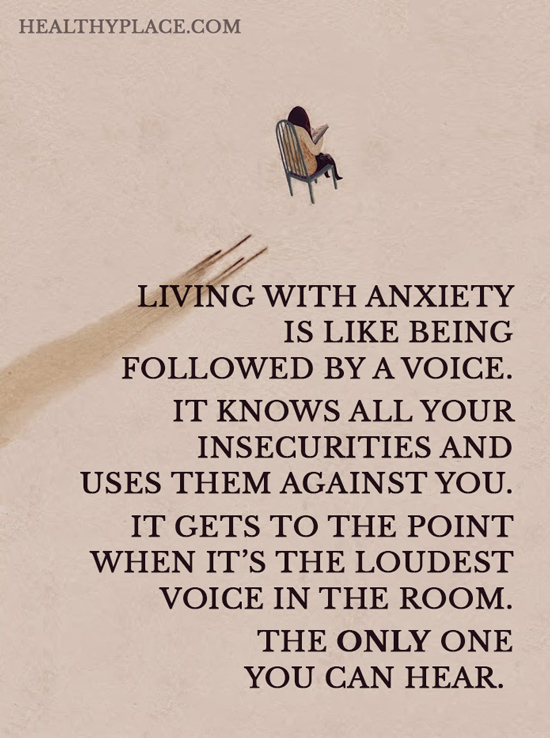
Anxiety has a voice too. The catch is that anxiety's voice sounds very, very much like your own.
Thoughts like "this is dangerous", "no one likes me", "I am failing" and "there is a six-headed monster behind the corner waiting to eat me" are classical examples of the anxiety talking. Real psychologists call these automatic thoughts. Thoughts that pop up without our permission, and which we accept without criticism.
Example: You ask your colleague something, and get a very short reply. If you have a poor self-image, you'll likely think they are mad at you for asking dumb things. This is your automatic thought.
The consequence is that you'll feel bad and might stop asking questions. Perhaps you blush, or feel annoyed or ashamed.
The only way to catch those thoughts is to learn to recognize them. So when you notice you are reacting (feeling something), stop. What am I feeling? Why am I feeling this? Is that true?
In our previous example it might go something like this:
- Automatic thought: Oh no, she's mad at me now! I did something wrong, I messed up. I'm such an idiot!
- Feeling: Embarrassed, wanting to disappear, disappointed at myself.
- STOP! Recognize the feeling.
- Why am I feeling this? I did something wrong.
- Is that true? Well.. I don't know? I have no real proof of that, actually. Wait, anxiety, did you just made me think that I suck, while I'm actually pretty okay?
See how the anxiety was trying to make a huge show of a small thing? In reality, maybe your colleague just was in a hurry, or in a call/ Maybe they dropped steaming tea on their lap - and still wanted to give you a reply as fast as they could!
We'll talk more about the spiraling anxiety and challenging your thoughts later more. For now let's focus on knowing that not each thought is our own. Not each thought is important. Some of them are downright lies, and can be ignored, stomped, burned, torn apart and forgotten.

No comments:
Post a Comment